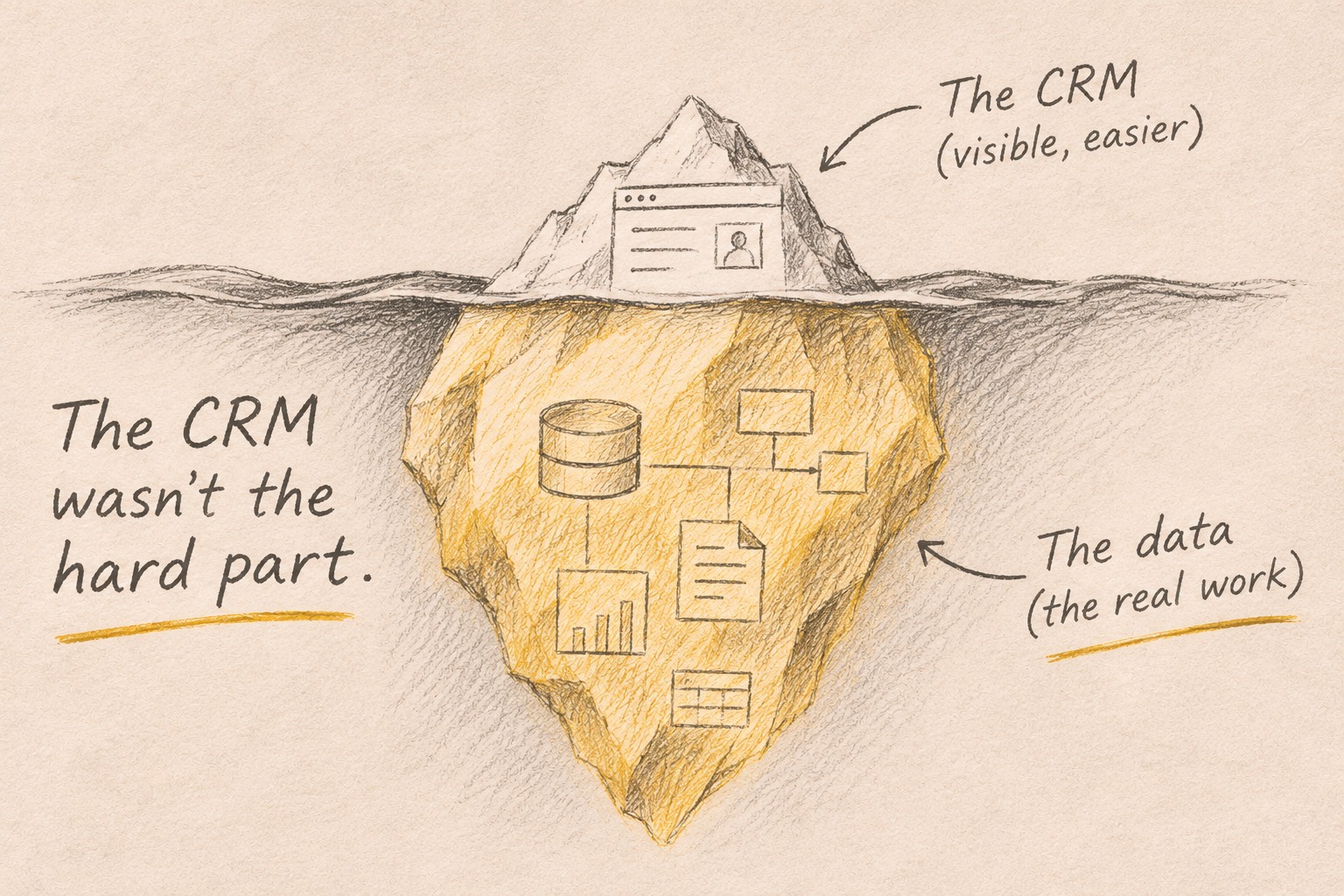
Moving ARC Gaming & Technologies off Salesforce took six months, December 2025 to May 2026, with both systems running side by side the whole time. The CRM was not the hard part. The hard part was keeping the data in step between the old system and the new one.
We decided to leave in December 2025. The customer is ARC Gaming & Technologies, and the reasons were not exotic. Their sales team could not use Salesforce to sell more. They needed a new instance for a new geography and could not afford it. The original implementation had been built by outside consultants. The in-house skills were in Salesforce administration, not in data architecture, data pipelines or ETL. The field app licence was expensive and there was no integration with phones. There were no pre-prospecting tools and no way to target from old data. By our estimate they used a small fraction of what they paid for. Research on how people use installed software describes narrow, shallow use,[1] but our figure is an estimate, not a measurement.
We did not start with the CRM. We built the Single Data Backbone first and automated the reporting on it. Then came the CRM. For ARC the CRM was an operational tool, not a sales tool, so we separated sales operations from it instead of copying Salesforce's shape.
The data broke after the CRM moved
This is what took longer than we expected. After the CRM moved, the operations team still needed the Accounts page in Salesforce. People were working in both systems, and the data between the two broke. Migration researchers describe a single cut-over as too risky for a system of any size and describe running old and new in parallel instead.[2]
We built bi-directional data pipelines to keep both sides in step. Keeping copies that are updated separately consistent is a known hard problem.[3][4] Mapping one field to another was not enough, because the problems were not field-to-field problems. They were about meaning. Data-integration researchers have said the same for years: writing the mappings takes business knowledge of what the data means, and the same value can mean different things in different contexts.[5][6]
Take "Active". In Salesforce, what made an account active was tribal knowledge. It depended on the warehouse location and the client location together, and it was written down nowhere. A Status-to-Status mapping carries the word across and loses what it meant. Pipeline status had the same problem: it meant one thing for an account under license A and another under license B.
What fixed it was an agentic judgement layer. For each change it works out what the change means before applying it on the other side. Language models have done well on data-matching benchmarks,[7] and one schema-matching study treats them as a starting point that people check.[8] We did not find a published study of using one the way we did. Even so, the sync fixes were not one piece of work that got finished. They went on for the whole six months.
Two other things ran long. Customizing the interface for different roles took longer than we expected. And once the system was in use, new people joined the company and asked for more features.
The thing that nearly kept us on Salesforce was the field iOS app. To replace the field apps we built Helix, which is real-time and offline-first. It was built over the last few months and operations has not adopted it yet. So we do not know yet whether it does the job in the field, and we will not claim it does.
Start with the data, not the CRM
The order mattered. Do the data first. We built the backbone before anything else, and we think that is why the rest held together when the sync kept breaking.
Be careful what you conclude from this. It is one customer, one team, one industry. It does not prove a move works for you, and we do not know if yours would take six months.
The wider order we would follow, from export to cancellation, is in Leaving Salesforce.
If you are partway into a move and your data is out of step between two systems, tell us where it is breaking. We will tell you what we did, and whether we think it applies to you.
Our own research
This is ours, not published research. Each item says how far it goes.
- Observation. At one customer, over six months, the data between Salesforce and the new system went out of step repeatedly, and the fixes went on for the whole period. One customer, one team, one industry. We did not count how often it happened.
- Observation. Two definitions nobody had written down: what made an account "Active" (the warehouse location and the client location together) and what a pipeline status meant (it differed between license A and license B).
- Hypothesis. In a CRM migration most sync breakage comes from differences in meaning, not from differences in field names or types. We have not counted defects by cause. To test it we would classify every sync defect in the next migration as structural or semantic.
- Hypothesis. A judgement layer that works out what a change means before applying it handles mismatches that fixed mapping rules miss. We have seen it work at one customer and have not compared it with a rules-only approach on the same changes.
- Hypothesis. Building the data layer first reduces rework later. We built it first once and cannot say what the other order would have cost.